

Double Beam vs Single Beam Spectrophotometer: A Detailed Comparison for Laboratories
Spectrophotometers are essential analytical instruments used across laboratories, research centers, pharmaceutical units, and quality control departments. When selecting the right instrument, one of the most common comparisons is Double Beam vs Single Beam Spectrophotometer. Understanding the working principles, advantages, and applications of each type helps laboratories make informed purchasing and operational decisions.
This Knowledge Center article explains the differences between Double Beam vs Single Beam Spectrophotometer, focusing on performance, accuracy, cost, and suitability for various laboratory environments.
What Is a Spectrophotometer?
A spectrophotometer is an analytical instrument that measures how much light a sample absorbs at a specific wavelength. It is widely used for quantitative analysis in chemistry, biology, pharmaceuticals, environmental testing, and food industries.
Based on optical design, spectrophotometers are primarily classified into:
- Single Beam Spectrophotometer
- Double Beam Spectrophotometer
The comparison of Double Beam vs Single Beam Spectrophotometer becomes crucial when accuracy and workflow efficiency are key requirements.
Single Beam Spectrophotometer: Working Principle
A single beam spectrophotometer uses one light path to measure absorbance. First, a reference (blank) is measured, followed by the sample measurement.
Key Characteristics of Single Beam Spectrophotometer
- Uses a single optical path
- Manual blank calibration required
- Simple instrument design
- Compact and cost-effective
Advantages
- Affordable for small laboratories
- Easy to operate and maintain
- Suitable for routine analysis
Limitations
- Requires frequent reblanking
- Not ideal for long-term or continuous measurements
In the Double Beam vs Single Beam Spectrophotometer comparison, single beam models are often preferred for basic applications with limited budgets.
Double Beam Spectrophotometer: Working Principle
A double beam spectrophotometer splits the light into two separate paths—one passes through the reference and the other through the sample simultaneously.
Key Characteristics of Double Beam Spectrophotometer
- Two optical paths (sample and reference)
- Automatic compensation for light source variations
- Continuous real-time measurement
Advantages
- Higher accuracy and stability
- No need for repeated blanking
- Ideal for research and quality control labs
Limitations
- Higher initial cost
- Larger instrument size
- Slightly complex optical system
When evaluating Double Beam vs Single Beam Spectrophotometer, double beam systems clearly offer superior precision for demanding applications.
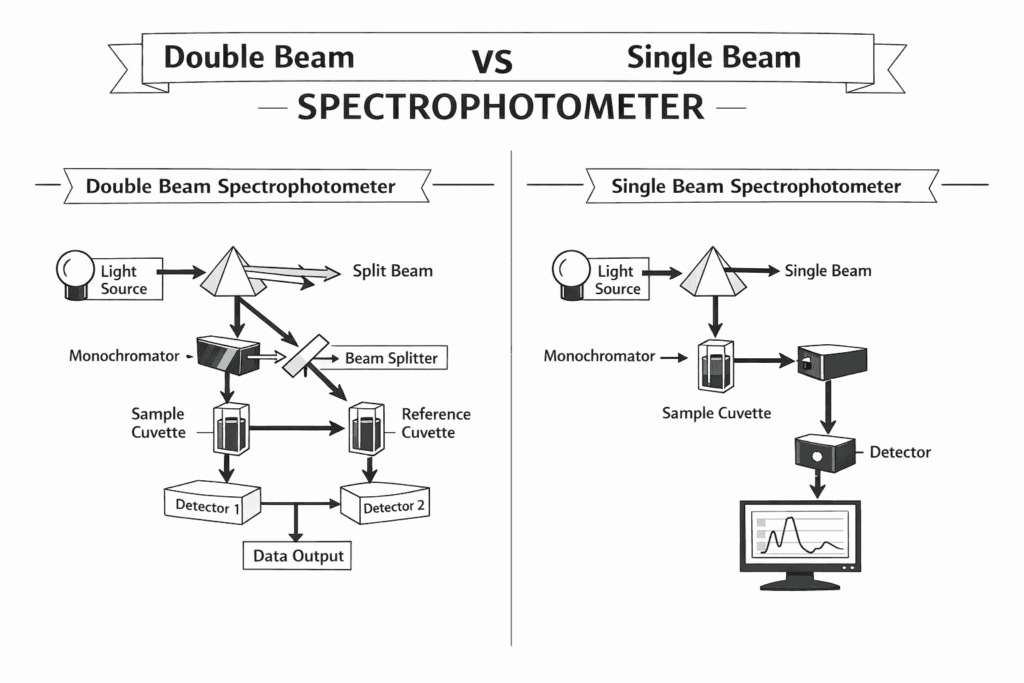
Double Beam vs Single Beam Spectrophotometer: Key Differences
Optical Design
-
Single Beam: One light path
-
Double Beam: Two simultaneous light paths
Accuracy and Stability
-
Single Beam: Affected by lamp intensity changes
-
Double Beam: Automatically compensates for fluctuations
Ease of Use
-
Single Beam: Manual blanking required
-
Double Beam: Continuous reference measurement
Cost Consideration
-
Single Beam: Economical option
-
Double Beam: Higher investment, better long-term performance
Application Suitability
-
Single Beam: Educational labs, routine testing
-
Double Beam: Research, pharmaceuticals, industrial QC
Applications Based on Laboratory Requirements
Choosing between Double Beam vs Single Beam Spectrophotometer depends on the type of analysis being performed.
Single Beam Applications
- Academic teaching laboratories
- Basic concentration measurements
- Field testing and small labs
Double Beam Applications
- Pharmaceutical analysis
- Chemical research and development
- Environmental monitoring
- High-precision quality control
For labs where reproducibility and reliability are critical, double beam spectrophotometers are the preferred choice.
Which Spectrophotometer Should a Lab Choose?
There is no universal answer in the Double Beam vs Single Beam Spectrophotometer debate. Laboratories must consider:
- Budget constraints
- Frequency of analysis
- Accuracy requirements
- Regulatory compliance
Single beam spectrophotometers serve well for routine tasks, while double beam systems support advanced analytical workflows.
Conclusion
The comparison of Single Beam vs Double Beam Spectrophotometer highlights that both instruments serve distinct laboratory purposes. Single beam spectrophotometers offer simplicity and affordability, making them ideal for basic applications. Double beam spectrophotometers, on the other hand, deliver superior accuracy, stability, and efficiency, making them suitable for research and industrial environments.
Selecting the right spectrophotometer ensures reliable results, optimized workflows, and long-term operational value for laboratories.
Contact Us
Website: www.labmart.in
Phone No.: +91-9667893959
FAQs
Q1. What is the main difference between double beam and single beam spectrophotometer?
Ans. The main difference lies in optical design. A single beam uses one light path, while a double beam uses two paths for sample and reference simultaneously.
Q2. Which is more accurate: double beam or single beam spectrophotometer?
Ans. comparison, double beam instruments are more accurate due to automatic compensation for light fluctuations.
Q3. Is a single beam spectrophotometer suitable for routine analysis?
Ans. Yes, single beam spectrophotometers are suitable for routine and educational laboratory applications.
Q4. Why are double beam spectrophotometers more expensive?
Ans. They use complex optics and dual detectors, offering higher stability and precision.
Q5. How to choose between double beam vs single beam spectrophotometer?
Ans. The choice depends on application complexity, accuracy needs, frequency of use, and available budget.

